Tragic End of a Legend: 15 Heartbreaking Facts About Zubeen Garg’s Death That Shocked the Nation

1. Introduction: shocking news of zubeen garg death
The news that zubeen garg death has stunned India and especially Assam is a heart-wrenching moment for millions of fans. On September 19, 2025, the music world lost one of its shining voices. The sudden and tragic nature of his demise has led to waves of shock, confusion, grief, and unanswered questions. In this article, we examine everything we know so far about zubeen garg death—from the timeline and medical details, to legal intrigue, public reaction, and legacy. We aim to present an authoritative, empathetic, well-sourced, and deeply human account, respecting both facts and feelings.
The journey here is not just about the event, but about preserving memory, demanding accountability, and honoring a towering musical icon whose voice continues to echo in hearts.
2. Who was Zubeen Garg? A brief biography
Zubeen Garg (born November 18, 1972 died September 19, 2025) was a multifaceted artist: singer, composer, actor, poet, director, and a cultural force in Assam and beyond. (Wikipedia)

He was born in Tura (Meghalaya) and spent his formative years in Assam. Over a career spanning more than three decades, he sang in dozens of languages, worked across genres, and carried Assamese music to national and international stages. (Wikipedia)
His early life involved struggle, persistence, and a deep attachment to his roots. For him, music was not just career but mission—celebrating regional identity while breaking boundaries. His fans often refer to him as Luit Kontho (voice of the Brahmaputra) and King of Humming. (Wikipedia)
That biography is not mere background—it reveals the weight behind the national grief at zubeen garg death. We’re not losing just a singer, but a symbol, a bridge, a voice.
3. Rise to stardom: career highlights
Zubeen’s breakthrough in the mainstream came with Ya Ali (from Gangster, 2006), which made him a household name in Bollywood. (People.com)
But that was only one milestone. In Assamese music circles, he had already been a force. He produced, composed, acted, directed films, and collaborated across language boundaries. (Wikipedia)
Some of his memorable works:
- Assamese chart-busters like Buku Duru Duru, Mayabini Ratir Bukut, and O Bondhu Re. (Wikipedia)
- Bollywood Hindi tracks and film soundtracks. (The Times of India)
- Experimental regional and folk songs, transcending linguistic borders. (Wikipedia)
He also helped launch and support emerging artists, did philanthropic work, and remained deeply connected to Assam’s cultural heritage. His crossing over from regional to national stages gave him a rare kind of credibility and influence.
4. Zubeen’s musical style and legacy
One reason Zubeen resonated so deeply was his ability to straddle folk roots and mainstream appeal. His style blended Assamese folk, Bihu rhythms, classical elements, pop sensibility, Bollywood gloss, and experimental textures. He had a knack for emotional nuance and vocal color.

In Assamese social and cultural discourse, he was more than entertainer; he was a guardian of identity. His songs often spoke to social issues, pride, nostalgia, and sensitivity. As one commentator put it, his death is not just personal loss—it wounds the Assamese collective consciousness. (NorthEast Now)
He leaves behind a huge discography, countless unreleased or ongoing projects, and a movement: aspiring artists citing him as inspiration, a musical standard to live up to. His legacy will be alive in how Assamese and Indian regional music continues to evolve.
5. The Singapore trip: what brought him abroad
At the time of his demise, Zubeen was in Singapore to perform at the North East India Festival (NEIF). (India Today)
The festival was organized by the High Commission of India and scheduled for September 20–21, 2025. (The Indian Express)
To mark this occasion, he travelled with associates, event organizers, security, and entourage. Some media reports say that on the day before the performance, there was a yacht trip and a swimming/sea outing plan. (www.ndtv.com)
That plan turned tragically consequential.
6. The fateful day: timeline of events
Piecing together multiple media reports, the timeline is roughly as follows (open to refinement with official investigation):
- Morning / midday, September 19: Zubeen joins a yacht/sea outing off Saint John’s Island (Singapore). (Wikipedia)
- He goes into sea water, possibly for scuba diving or swimming, accompanied by associates. (People.com)
- During the water activity, he reportedly experienced breathing difficulty or a seizure / medical emergency. (India Today)
- He was rescued or brought out of the water; CPR was attempted. (People.com)
- He was transported to Singapore General Hospital (SGH), admitted to ICU. (People.com)
- At around 2:30 PM IST (Singapore time adjusted), he was pronounced dead. (The Indian Express)
Because several media sources differ in small details (scuba vs swimming, exact moment of onset, location), the investigation currently must clear ambiguities. (India Today)
7. Was it scuba diving or swimming?
One of the enduring controversies around zubeen garg death is whether he was scuba diving or simply swimming during the sea outing. Some reports label it a scuba diving accident; others assert he was in open water without scuba gear.
- Some sources say he was performing scuba diving when breathing issues set in. (People.com)
- Other reports quote the Assam CM and officials asserting that he was not diving with scuba equipment; instead he was swimming without a life jacket. (Wikipedia)
- The initial Singapore death certificate reportedly cites drowning (not decompression injury or scuba accident) as cause. (India Today)
This confusion matters: scuba diving involves specialized gear, deeper depths, and added risk factors (decompression, nitrogen narcosis). Swimming involves surface risks, currents, exhaustion, or medical emergency. The precise mode could shape causation, liability, and criminal vs negligent classification of death.
8. Medical emergency: breathing difficulty, seizure
Multiple media sources mention that Zubeen faced breathing distress or possibly a seizure while in water. (India Today)
Experts in aquatic safety and medicine note that in open water, a submerged seizure or sudden cardiac event can quickly lead to drowning, even if rescue is prompt. Hypoxia (lack of oxygen) can happen within seconds.
Given that Zubeen was a “water baby” (he had posted pictures enjoying seas and waves) (www.ndtv.com), he likely was comfortable in water. But even experienced swimmers can succumb to a sudden medical collapse, cramps, cardiac event, or aspiration of water.
At present, no independent and publicly verified medical expert has published a full detailed cause (beyond “drowning”)—which is why the second post-mortem and forensic probe are so critical.
9. Rescue efforts and hospital admission
After the medical event in water, reports say that Zubeen was pulled from the sea, and CPR (cardiopulmonary resuscitation) was attempted immediately. (People.com)
Then he was rushed to Singapore General Hospital and admitted into the intensive care unit (ICU) for stabilization. (India Today)
Despite best efforts by medical staff, he could not be revived. The official pronouncement came later in the day. (The Indian Express)
One crucial question is how much time elapsed between the event and hospital arrival—and whether any earlier interventions (on the yacht, on rescue boats) were timely and adequate. The investigation will likely examine the chain of custody of care.
10. Official cause: drowning as per Singapore authorities
The Singapore authorities’ death certificate lists drowning as the cause of death. (India Today)
That official stance is central to legal and medical narratives: it implies no overt external trauma or obvious foul play (based on currently published information). But many in Assam and among fans have questioned whether the drowning label alone explains everything. (India Today)
Hence, the Assam government demanded—and secured— a second post-mortem in India (Gauhati Medical College) in response to public pressure. (India Today)
The second autopsy is intended to validate, complement, or question the original report. That step is vital for trust, transparency, and legal clarity.
11. Local outcry: doubts and demand for justice
Almost from the moment the news broke, voices in Assam and across India raised skepticism. Many questioned the speed of the death certificate, the lack of immediate transparency, and the possibility of foul play. (India Today)
The Assam Chief Minister himself, responding to public sentiment, ordered a full investigation and asked for a second post-mortem. (The Times of India)
Opposition leaders and some social activists have demanded that CBI (Central Bureau of Investigation) be brought in. (The Times of India)
Controversies over arrests, haste, and political interference have also fueled the outcry. Some fear that powerful interests may be shielding facts. (The Hans India)
In short: the public is demanding not just an answer, but accountability.
12. Second post-mortem in Assam
To address doubts, Assam’s authorities conducted a second autopsy at Gauhati Medical College just before the funeral. (India Today)
This second examination is intended to act as a check, ensuring that no detail is missed or suppressed. It also serves symbolic and social purposes—reassuring the public that the matter is taken seriously.
The outcome of that second post-mortem has not yet been publicly released in full, as several forensic, histological, and biochemical tests take time. Meanwhile, the investigation remains active. (Deccan Herald)
From a trust standpoint, this step bolsters credibility: it shows that authorities are open to scrutiny and not simply relying on external findings.
13. FIRs, arrests and suspects
As of now, seven people have reportedly been arrested in connection to the zubeen garg death case. (The Times of India)
Key FIRs have been filed against the event organizer, the singer’s manager, and others, on grounds of negligence, failure to ensure safety, and possible culpable homicide. (The Times of India)
Some arrested include:
- DSP Sandipan Garg, the singer’s cousin, who was with him in Singapore. (The Times of India)
- The event organizer Shyamkanu Mahanta and singer’s manager Siddhartha Sharma. (Deccan Herald)
- Two personal security officers (PSOs) for Garg—Nandeswar Bora and Paresh Baishya—arrested following discovery of suspicious financial transactions. (The Tribune)
- Musicians or participants present on the yacht, such as Shekhar Jyoti Goswami, have also been detained by SIT. (OdishaBytes)
The progression of arrests suggests the probe is widening from direct incident participants to financial and organizational angles.
14. Role of the event organizer and manager
The event organizer and the singer’s manager are under scrutiny because they held responsibility for safety logistics, scheduling, transport, gear, permissions, and oversight. If proper risk assessments, safety protocols, life jackets, medical backup, or monitoring were lacking, negligence charges may stick.
FIRs allege that they failed to ensure adequate safety measures, and some suggest that they pushed the schedule or pressured participants. (The Times of India)
The defense (pending public records) may argue that the singer and participants had autonomy, or that unforeseen medical emergency could not have been predicted. But establishing or refuting such a defense hinges on forensic and logistical evidence—documents, witness statements, timeline, contracts, equipment. The case may turn on “duty of care.”
15. Role of cousin DSP Sandipan Garg
One of the most charged elements is the arrest of Sandipan Garg, Zubeen’s cousin and Assam DSP, who was reportedly present in Singapore and on the yacht. (The Times of India)
His arrest by SIT (for 7 days custody) has raised eyebrows. Some allege conflict of interest: could he influence local or Assamese police, or hide critical details? (The Times of India)
He has publicly declared cooperation, but the optics of a relative being involved in a probe complicate perceptions of impartiality. The investigation must handle this with clear transparency so that no one suspects a cover-up.
16. Suspicious transactions via personal security officers
Another revealing angle is financial. SIT investigators uncovered that approximately Rs 1 crore (or more) was transacted through accounts of the singer’s PSOs (Nandeswar Bora, Paresh Baishya) over recent years. (The Economic Times)
This money trail raises questions of motive, influence, payoffs, or undisclosed relationships. If those PSOs were acting as conduits, their involvement may not be just protective, but transactional.
These findings led to the arrest of the PSOs. (The Statesman)
Investigators will likely examine bank statements, source of funds, linked accounts, audits, and whether the funds were related to management or outside entities. If corruption or conspiracy emerges, the case may escalate beyond mere negligence.
17. The yacht party: alleged events and witnesses
Much of the public and legal focus centers on the yacht party in Singapore—the last known setting before Zubeen’s tragedy. Reports say that 11 NRIs (non-resident Indians) who were present at that yacht have been summoned for statements. (www.ndtv.com)
Witnesses are crucial: who saw Zubeen go into water, who assisted, who heard him struggle, who gave first aid, who transported him. Some media accounts indicate that while Zubeen was struggling, one of his associates on board sang “Jabo De, Jabo De”—raising chilling questions of attitude and timing. (Maharashtra Times)
As the SIT expands statements, these testimonies may clarify exactly how long he was underwater, who responded, and whether delays or negligence occurred. The credibility of each witness (affiliation, motives, consistency) will matter enormously.
18. Detained musicians and participants
Among those detained is musician Shekhar Jyoti Goswami, who reportedly was present on the yacht with the singer. (OdishaBytes)
Information about his involvement (whether he attempted rescue, made statements, withheld help) is not fully public yet. Other participants, including co-singers or expatriates, are also being questioned. (The Times of India)
These detentions show that investigators are casting a wide net—not only focusing on the central figure, but everyone present at the scene. That is consistent with rigorous investigation norms.
19. Political reactions and controversies
Given Zubeen’s prominence and public sensitivity, his death has become politically charged. Assam’s ruling government has promised full inquiry, judicial commission, and accountability. (The Economic Times)
Opposition leaders, such as Gaurav Gogoi (Congress MP), criticized what they call “hasty arrests” and politicization, demanding transparent, professional investigation. (The Hans India)
Some allegations involve linking event organizers with political actors, or that certain individuals are being shielded. (The Indian Express)
These tensions make it all the more important for investigators to stay independent, impartial, and above reproach, lest the case become a lightning rod for controversies.
20. Public mourning: Assam in grief
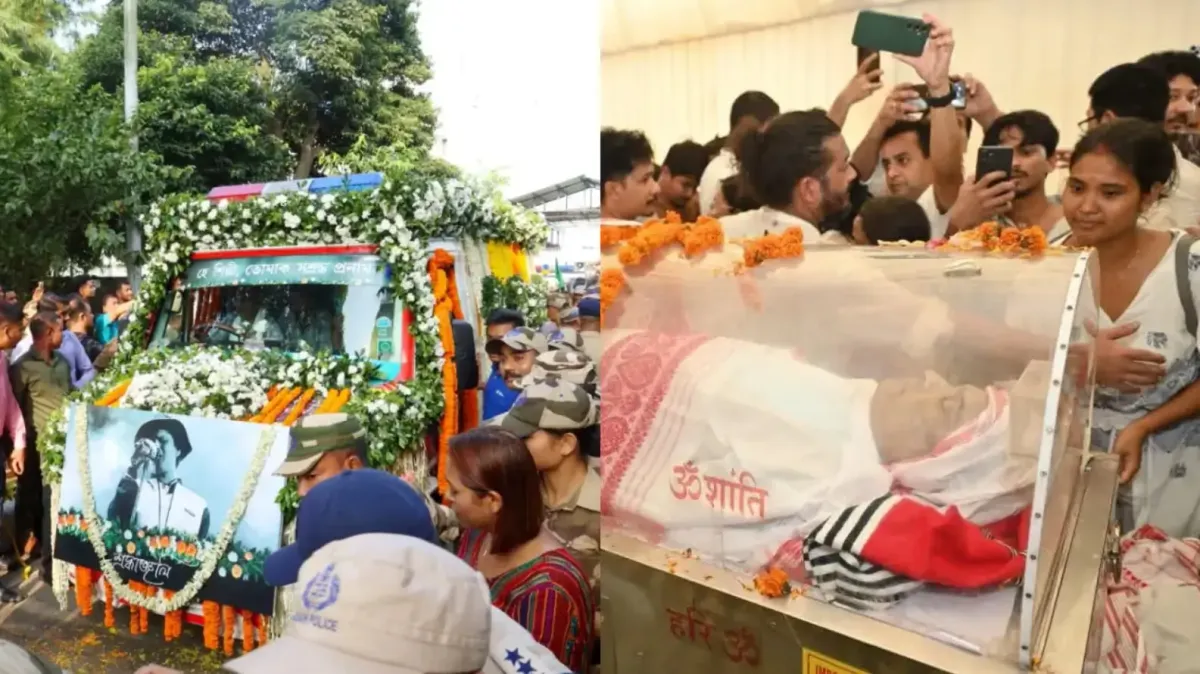
The sheer outpouring of grief was visible on the streets, in homes, in social media, in offices, in schools. In Guwahati, normal life ground to a halt: shops closed, flags half-mast, spontaneous tributes sprouted across the city. (www.ndtv.com)
Thousands lined the 25-kilometer route from the airport to Zubeen’s residence to pay respects. (www.ndtv.com)
In other towns and villages across Assam, memorial events, candle vigils, collective singing of his songs took place. The sense of loss is deeply personal to many. (NorthEast Now)
Observing the public outpouring helps us understand that zubeen garg death is not just entertainment news—it’s a moment of collective cultural mourning.
21. Cultural impact: Assamese identity and mourning
In many analyses, Zubeen’s death is seen as symbolic of a deeper cultural void. He was viewed not just as a singer, but as Assam’s voice to the world. His absence raises questions: who now carries that mantle? Can regional music sustain itself at that level? (NorthEast Now)
His passing sparked renewed discourse about language, culture, tourism, and self-esteem in Assam. Many see it as a wake-up call: to protect cultural heritage, support regional arts, strengthen safety in performance circuits, and ensure that legacy is institutionalized. (NorthEast Now)
The mourning itself has become part of cultural memory. In years to come, the way people reminisce about 2025 in Assam will forever carry zubeen garg death as a milestone.
22. Tributes from other artists and institutions
Following his demise, artists from across India poured out heartfelt tributes. Bollywood composers, singers, directors—everyone acknowledged his contribution and lamented the loss. (The Times of India)
Institutions, state governments, cultural societies announced memorial concerts, awards in his name, and plan to preserve his recordings and archives. The Assam government declared three days of state mourning. (The Times of India)
National media covered his life, achievements, and death with the gravitas usually reserved for legends. Such solidarity enriches his legacy and ensures his name will continue to reverberate.
23. Funeral, cremation, memorials
His last rites took place on September 23, 2025 near Guwahati, with full state honours. (The Times of India)
His body was kept at a sports complex in Guwahati so fans could pay homage. (Wikipedia)
He was cremated at Kamarkuchi NC village in Sonapur area, with a 21-gun salute. (Wikipedia)
Later, his ashes were brought to Jorhat for the 13th-day ritual (Adyashraddha). (Wikipedia)
The scale of the funeral—mass participation, official honours—speaks volumes. Some reports say it became one of the largest public farewells in Assam’s history. (The Times of India)
Authorities also plan memorials in Guwahati and Jorhat to keep his memory alive. (Wikipedia)
24. Legacy: what Zubeen leaves behind
Zubeen Garg left behind:
- A massive body of work: thousands of songs across languages. (Wikipedia)
- Incomplete projects, films, recordings—some in the pipeline.
- A generation of younger musicians inspired by him, who now must carry forward his ethos.
- Institutional memory: archives, awards, cultural programs planned in his name.
- A wider national recognition for Assamese and regional music traditions.
His voice, once lost, lives in recordings, hearts, and cultural memory. That, in many ways, is the most enduring legacy.
25. Safety in water sports: expert warnings
One lesson from zubeen garg death is water safety. Whether one is a seasoned swimmer or novice, risks abound: sudden medical collapse, cramps, currents, shallow water blackouts, inadequate equipment, lack of supervision.
Experts usually recommend:
- Use life jackets or flotation devices
- Continuous supervision by trained lifeguards
- Pre-check medical fitness, especially for cardiac or seizure history
- Rapid rescue readiness (emergency protocols, first responders)
- Limit risky activities (deep dives, remote spots)
This is not blame, but prudence. If negligence on safety contributed, demands for accountability are ethically grounded.
26. Legal path ahead: potential outcomes
As the investigation proceeds, possible legal consequences include:
- Culpable homicide or negligent death charges, if proof shows negligence
- Criminal liability for organizers, manager, security, participants
- Civil suits by the family against responsible parties
- Compensation, damages, or punitive law suits
- Exoneration of innocents, if evidence absolves them
The outcome depends on forensic findings, testimony credibility, motivation/traces (like financial trails), and how judicial and investigative integrity is maintained.
27. How media, misinformation, rumors swirl
In high-profile tragedies like zubeen garg death, rumors and false claims proliferate—especially in social media. Some claim conspiracy, foul play, coverups, suppressed documents—even when unverified.
Investigators, media, and citizens must tread carefully: corroborate sources, avoid sensationalism, await credible evidence. The second post-mortem, court orders, custodial statements, financial audits—all must become public (to the extent allowed legally) to combat misinformation.
Transparent updates, press briefings by SIT, and clear communication can help maintain trust and reduce rumor damage.
28. FAQs about zubeen garg death
Q1: What is the exact cause of zubeen garg death?
As per Singapore authorities, the cause is drowning. However, a second post-mortem in Assam is ongoing to investigate supporting evidence and any alternate causation. (India Today)
Q2: Was Zubeen Garg scuba diving or swimming?
Media reports differ: some say he was scuba diving, others assert he was swimming without scuba gear. The discrepancy is a central point of ongoing investigation. (India Today)
Q3: Who has been arrested in connection with zubeen garg death?
Arrests include DSP Sandipan Garg, event organizer, singer’s manager, two PSOs, musicians present on the yacht, and others. In total, seven people have been detained so far. (The Times of India)
Q4: What role did financial transactions play?
Investigators found money transfers of around Rs 1 crore through the singer’s PSO accounts. This trail is being probed for motive or hidden relationships. (Firstpost)
Q5: Has a judicial commission been formed?
Yes, a judicial inquiry is reportedly ordered by Assam’s government to complement SIT investigation.
Q6: What is the legacy of Zubeen Garg now?
His legacy includes his expansive music, his cultural influence in Assam and India, the inspiration he gave to budding artists, and the institutional memorials planned in his name.
29. How to remember and honor Zubeen Garg
Fans, institutions, and communities can honor his memory by:
- Holding tribute concerts, especially in Assam, with proceeds to budding musicians
- Archiving and digitizing his recordings, lyrics, interviews
- Introducing scholarships or awards in his name
- Encouraging young artists to imbibe his ethos of cultural rootedness + innovation
- Establishing museums or memory walls in Assam
- Continuing dialogue on water safety and artist protection
His memory lives when younger generations connect with his art, carry forward his values, and ensure that the lessons from his death lead to better practices.
30. Conclusion: hope, accountability, legacy
The headline zubeen garg death signals a tragic end to an enormously gifted life. Yet beyond grief, this moment also demands clarity, justice, and continuity. Fans, family, and the people of Assam deserve full, transparent answers—not speculation.
As the investigation unfolds, the truths it uncovers must be respected. But equally important is how society responds: preserving Zubeen’s art, supporting regional music, ensuring safety in art circuits, and keeping culture vibrant.
Zubeen Garg is gone in body, but not in voice. In remembering him with honesty and purpose, we can turn this loss into a renewed commitment to music, integrity, and dignity.