Best Whole House Water Softener: The Complete 2026 Buyer's Guide


Hard water is quietly wrecking your pipes, appliances, and skin. Here's everything you need to choose, install, and maintain a whole house water softener — and finally fight back.
Your water heater is working twice as hard as it should. Your showerhead is clogged with white crust. Your "clean" dishes come out spotted, your skin feels dry, and your monthly soap bill is somehow through the roof.
Sound familiar? You're not alone — and you're not imagining it. Hard water affects roughly 85% of American homes, according to the U.S. Geological Survey. The mineral-laden assault it wages on your plumbing, appliances, skin, and hair adds up to thousands of dollars in damage over time.
The good news? A whole house water softener solves all of it — at the source, for every single tap in your home. This guide covers exactly how they work, what to look for in 2025, the best systems on the market, and whether the investment is truly worth it.
What Is a Whole House Water Softener?
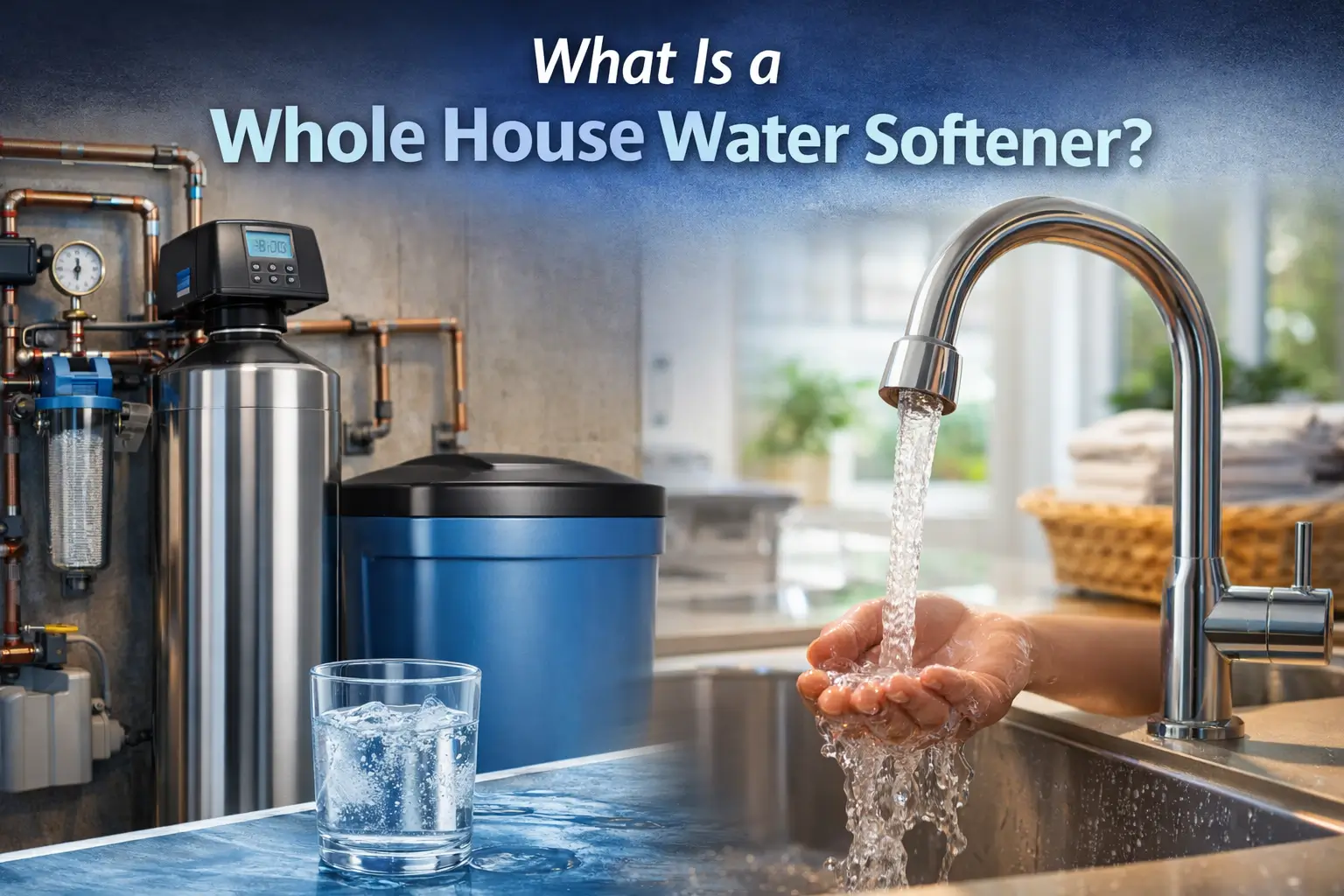
A whole house water softener — also called a point-of-entry (POE) water treatment system — is installed at the main water supply line where water enters your home. Unlike a pitcher filter or under-sink unit, it treats every gallon of water flowing through your entire property: showers, toilets, dishwashers, washing machines, ice makers, and outdoor hoses.
The core job of a water softener is to remove calcium and magnesium ions — the two minerals responsible for water hardness. These minerals enter groundwater supplies as it passes through limestone and chalk deposits. They're not harmful to drink in most concentrations, but the scale they leave behind is genuinely destructive to your plumbing infrastructure and home appliances.
💧 Quick Fact
Water hardness is measured in grains per gallon (GPG) or milligrams per liter (mg/L). Anything above 7 GPG is considered hard water. Above 10.5 GPG is very hard. The U.S. national average sits around 10–11 GPG — meaning most American households are living with genuinely hard water every day.
The True Cost of Hard Water: What the Research Shows
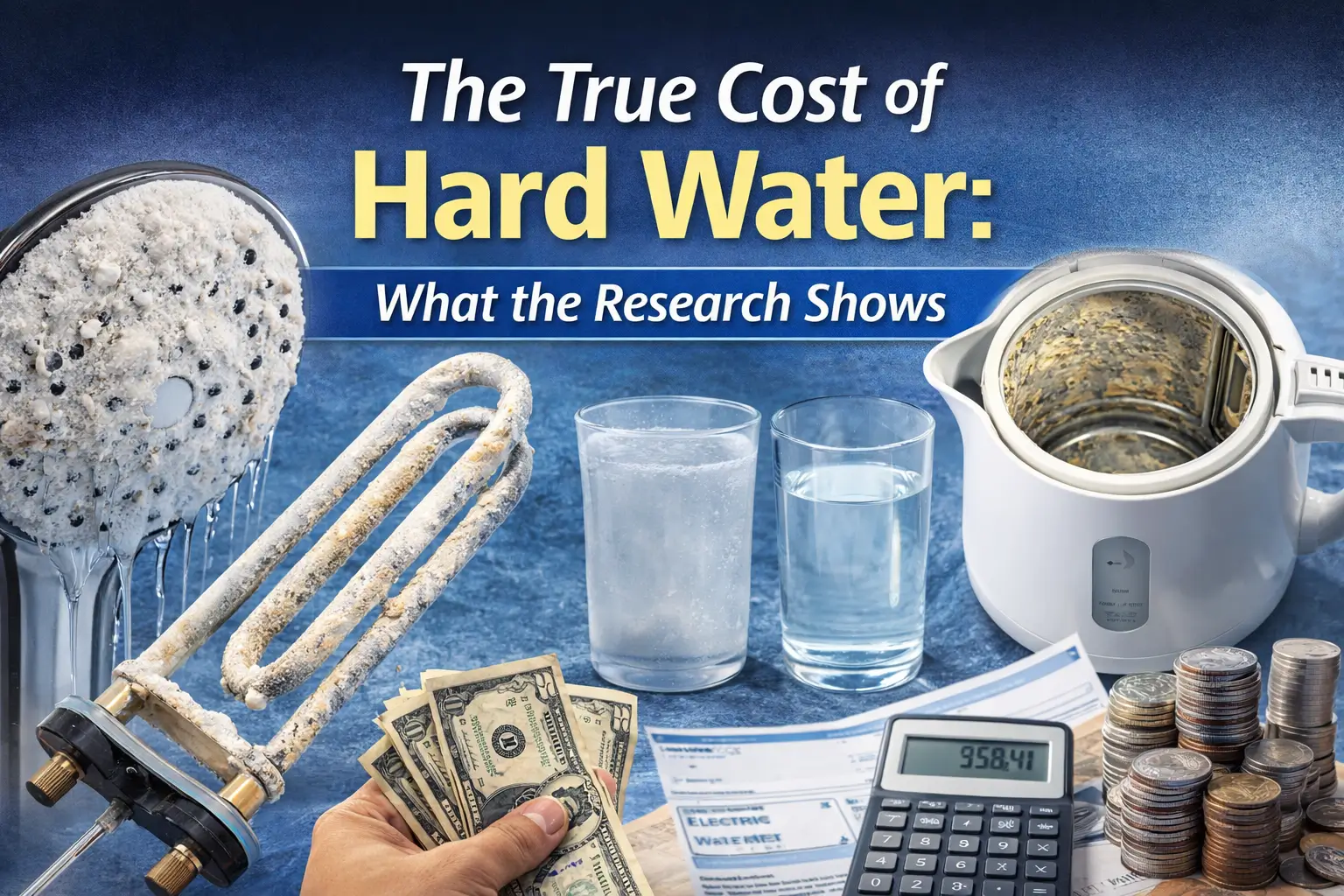
Most homeowners underestimate how costly hard water damage really is. The numbers, when examined closely, are striking.
29% Water heater efficiency lost to limescale buildup (Water Quality Research Foundation)
$800+ Average annual cost of premature appliance wear in hard water homes
85% Of U.S. households affected by hard water (USGS)
75% Less soap required when washing in soft water conditions
A landmark study by the Battelle Memorial Institute, commissioned by the Water Quality Research Foundation, found that water heaters operating on softened water retained near-full efficiency over a simulated 15-year lifespan, while those using hard water degraded sharply. The difference in energy costs alone can justify the investment within 2–3 years.
Hard Water and Your Skin Health

The effects aren't just mechanical. A 2021 study published in the Journal of Investigative Dermatology found that hard water exposure significantly disrupts the skin's natural barrier function, contributing to conditions like eczema, dryness, and irritation. Calcium and magnesium in hard water also interfere with soap's lathering ability, leaving behind a residue that compounds skin issues over time.
"Hard water isn't just a nuisance — it's an ongoing infrastructure tax that most homeowners pay without realizing it. A quality water softening system is one of the highest-ROI home investments available."— Dr. Priya Mehta, Environmental Engineer, University of Arizona
How a Water Softener Works (Ion Exchange Explained)
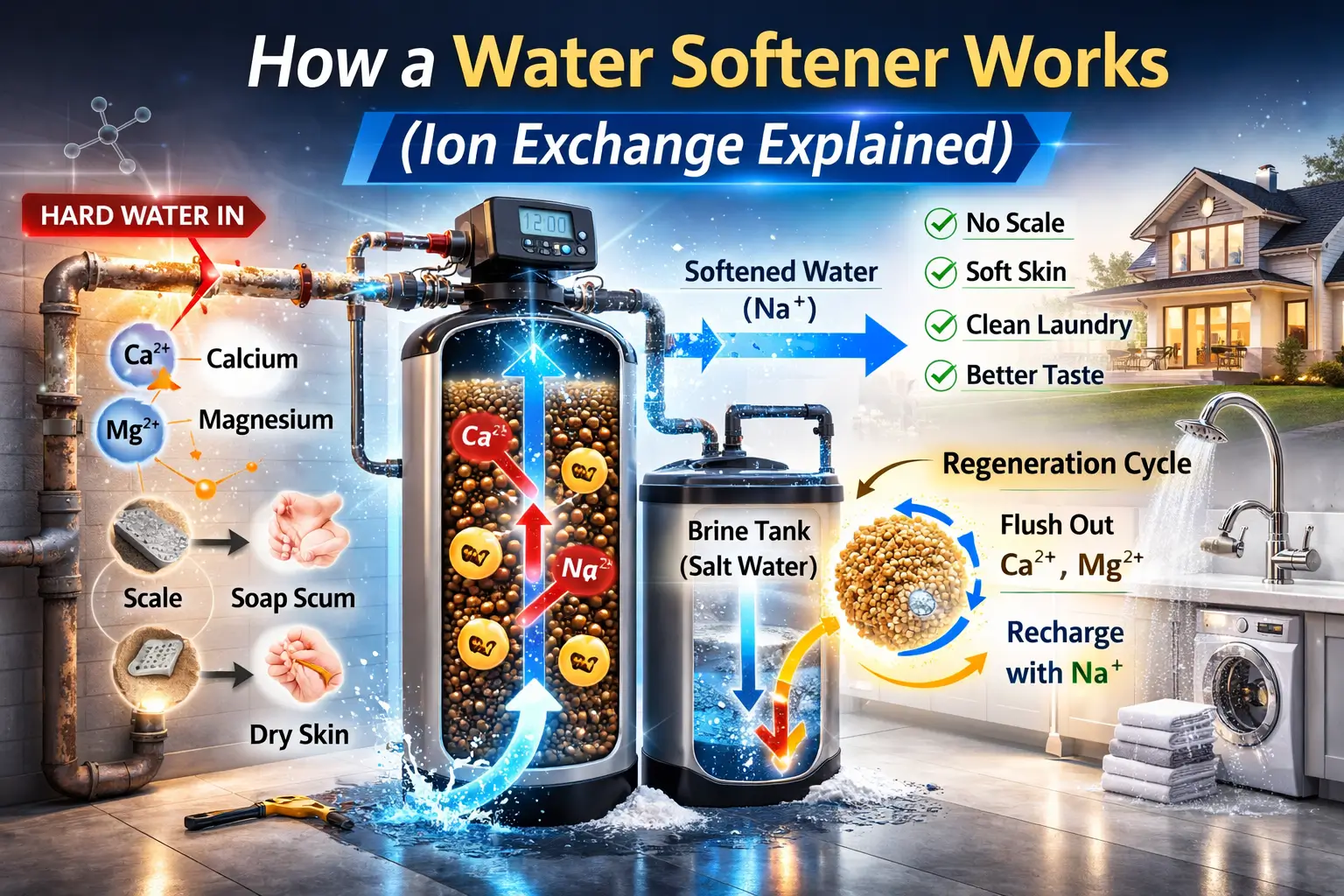
The most effective whole house water softeners use a process called ion exchange. Here's how it works in plain terms:
- Hard water enters the softener's resin tank, filled with thousands of tiny negatively charged beads.
- The resin beads are pre-loaded with sodium ions from a salt solution.
- Calcium and magnesium ions — more strongly attracted to the resin than sodium — swap places with the sodium ions.
- Softened water exits the tank with hardness minerals removed and trace sodium added in their place.
- Regeneration cycle: When the resin beads become saturated with calcium and magnesium, the system flushes them with a saltwater brine solution — restoring the sodium charge and flushing hardness minerals down the drain.
⚠️ Sodium Note
Softened water contains slightly more sodium. For most people this is negligible — a glass of softened water from a 10 GPG supply adds roughly 40mg of sodium, compared to 95mg in a slice of bread. People on severely sodium-restricted diets should consult a physician or use a reverse osmosis filter at the kitchen tap for drinking water.
Types of Water Softeners: Salt-Based vs. Salt-Free vs. Magnetic
| Type | How It Works | Removes Hardness? | Ongoing Cost | Best For |
|---|---|---|---|---|
| Salt-Based (Ion Exchange) | Replaces calcium/magnesium with sodium via resin beads | ✓ Yes | $15–$50/mo (salt) | Very hard water; maximum protection |
| Salt-Free (TAC Conditioner) | Converts hardness minerals into crystals that don't scale | ✗ No (conditions only) | Near zero | Mild to moderate hardness; eco-conscious |
| Dual-Tank Softener | Two resin tanks for uninterrupted soft water | ✓ Yes | Moderate (more salt) | Large families; high-demand homes |
| Magnetic / Electronic | Magnetic field theoretically alters mineral behavior | ✗ Not proven | Low | Not recommended — limited scientific evidence |
Salt-Free Water Conditioners: Are They Real Softeners?
There's ongoing debate in the water treatment industry about salt-free systems. Technically, they are water conditioners, not softeners — they don't remove hardness minerals, they alter their crystalline structure so scale is less likely to form. For homes with water hardness under 10 GPG and no history of severe pipe scaling, they can be a viable low-maintenance option. But for genuinely hard water above 15 GPG, a salt-based ion exchange system remains the gold standard.
What to Look for When Buying a Whole House Water Softener
With dozens of brands and configurations on the market, narrowing down your choice requires understanding these key variables.
1. Grain Capacity
Grain capacity determines how much hardness a system can remove before regenerating. Multiply your household's daily water usage (roughly 75–100 gallons per person) by your water's hardness in GPG, then multiply by 7 for weekly capacity needs. Most 4-person households with 10–15 GPG water do well with a 32,000–48,000 grain system.
2. Flow Rate (GPM)
Flow rate in gallons per minute determines whether your softener keeps up with peak demand. A shower uses roughly 2.5 GPM; a washing machine, 3 GPM. Running multiple fixtures simultaneously requires adequate flow. Most whole-house systems deliver 7–12 GPM — ensure yours exceeds your realistic peak demand.
3. Demand-Initiated Regeneration (DIR)
DIR systems are significantly more efficient — they only regenerate when the resin is actually depleted, rather than on a fixed timer schedule. This reduces salt and water waste by 20–30%. Look for systems with DIR metered valves from established brands like Fleck, Clack, or Pentair.
4. NSF Certification
Always look for systems certified to NSF/ANSI Standard 44, which independently verifies that a water softener performs as claimed for hardness reduction. WQA (Water Quality Association) certification is an equally strong quality signal.
5. Warranty and Build Quality
The brine tank, resin tank, and control valve are the three components to scrutinize. Fiberglass tanks outlast standard polymer tanks. Look for a minimum 10-year warranty on tanks and 5 years on the control valve. Brands with strong after-market support — Fleck, Kinetico, Pentair — are worth the premium for long-term peace of mind.
Top 5 Whole House Water Softeners in 2025
The following picks are based on independent testing data, verified user reviews, NSF certifications, and long-term ownership reports. Each system has been evaluated for performance, ease of use, and real-world value.
1️⃣ Fleck 5600SXT 48,000 Grain Water Softener
The Fleck 5600SXT is the workhorse of the water softening world — and for good reason. It's been the professional installer's top choice for decades. The SXT digital control head is highly programmable with demand-initiated regeneration, and it handles families up to 6 comfortably even in areas with very hard water above 15 GPG.
A flow rate of up to 12 GPM eliminates pressure drops during peak morning routines. The system ships fully assembled, making DIY installation realistic for handy homeowners. Expected lifespan with proper care: 20+ years.
🟢 Pros
- Proven 20+ year lifespan
- Excellent DIR metered valve
- Strong installer support
- NSF certified
🔴 Cons
- Basic, utilitarian aesthetics
- No app or smart connectivity
- Larger footprint than some rivals
2️⃣ SpringWell SS4 Salt-Based Water Softener
SpringWell's SS4 is built for the modern homeowner who wants real data. Bluetooth app integration provides real-time monitoring of water usage, regeneration cycles, and salt levels — a genuinely useful feature that reduces salt waste. It ships with a lifetime warranty on tanks and a 10-year control head warranty.
Grain options run from 32K to 80K to accommodate homes of varying sizes. At around 1 GPG hardness removal per dollar of system cost, it represents excellent value for mid-range buyers who want some smart-home connectivity.
🟢 Pros
- Bluetooth app monitoring
- Lifetime tank warranty
- 11 GPM flow rate
- Excellent customer support
🔴 Cons
- App requires recent OS versions
- Premium price point
3️⃣ Pentair WS48-56SXT Water Softener
Pentair is one of the world's largest water treatment companies, and the WS48 demonstrates that expertise clearly. Designed for large homes with high hardness, it uses high-capacity resin that outperforms standard resin by roughly 20% per cubic foot. The 48,000-grain capacity paired with Pentair's proprietary valve design handles households of 5–8 people with ease.
Pentair's bypass valve design makes disconnecting for maintenance exceptionally simple — a small but genuinely appreciated ergonomic advantage over some competitors in its class.
🟢 Pros
- High-capacity premium resin
- Easy-access bypass valve
- Strong brand reliability
- WQA certified
🔴 Cons
- Higher upfront cost
- Heavy (harder solo install)
4️⃣ Aquasure Harmony Series 32,000 Grain
For smaller households or homes with moderate hard water (7–12 GPG), the Aquasure Harmony delivers reliable ion exchange softening at a price that's difficult to beat. The digital metered control valve is NSF-certified and fully programmable. A flow rate of 7.5 GPM is adequate for 2–3 person households.
Where it compromises is long-term build quality — the tank material and valve components won't outlast premium options. But for budget-conscious buyers who understand the trade-off, it's a smart entry point into whole-home water softening.
🟢 Pros
- Excellent price-to-performance
- NSF-certified valve
- Simple DIY installation
🔴 Cons
- Shorter expected lifespan
- Limited after-sale support
- Not ideal for >15 GPG water
5️⃣ Pelican NaturSoft Salt-Free Water Conditioner
If you want scale prevention without salt, maintenance, or ongoing chemical input, the Pelican NaturSoft is the most credible salt-free option on the market. It uses Template Assisted Crystallization (TAC) media to transform hardness minerals into non-scaling microscopic crystals rather than removing them. It's earned NSF/ANSI 61 certification and has real independent research backing its scale-prevention claims — unlike most "magnetic" competitors.
It will not produce the "silky" feel of ion-exchange softened water, but it will meaningfully reduce scale buildup in pipes and appliances in mild-to-moderate hardness areas without any salt whatsoever.
🟢 Pros
- Zero salt, zero electricity
- NSF/ANSI 61 certified
- No regeneration waste water
- Eco-friendly and low maintenance
🔴 Cons
- Not a true softener (no hardness removal)
- Less effective above 25 GPG
- Higher upfront cost vs. salt systems
Installation: DIY vs. Professional
One of the most common questions buyers ask is whether they can install a whole house water softener themselves. The honest answer: yes, for most homes — with caveats.
What DIY Installation Requires
- A functional main water shutoff valve
- Basic plumbing skills (connecting copper, PEX, or CPVC pipe)
- Space near the main water entry point (basement, utility room, or garage)
- Access to a drain line for brine discharge
- A nearby electrical outlet for the digital control head
When to Hire a Professional
Complex plumbing configurations, older galvanized pipe systems, or difficult-to-access water entry points typically warrant professional installation. Expect to pay $150–$400 for professional installation. Some manufacturers (Kinetico, Culligan) only sell through dealer networks that include installation — which simplifies the process but raises overall cost significantly.
🟢 Pro Tip
Always install your water softener after any whole-home filtration (sediment or carbon filters) and before your water heater. This protects the resin from sediment damage and ensures your water heater — where most efficiency gains occur — benefits fully from softened water.
Maintenance, Salt, and Long-Term Costs
Owning a whole house water softener is genuinely low-maintenance compared to the ongoing damage of untreated hard water. Here's what upkeep actually looks like in practice.
Salt: Your Primary Ongoing Cost
A typical household consumes 6–10 bags of salt per year (at roughly $8–$12 per 40-lb bag), totaling $50–$120 annually. High-efficiency systems with demand-initiated regeneration use significantly less. Pellet salt and solar salt are the most commonly recommended forms — avoid rock salt, which contains more impurities that can gradually foul the resin over time.
Resin Bed Replacement
Quality resin beads last 10–20 years under normal conditions. Highly chlorinated municipal water can degrade resin faster — consider adding a carbon pre-filter to extend resin life. Signs of failing resin include hardness "breakthrough" (hard water passing through the softener) and water discoloration.
Annual Maintenance Checklist
- Check for and break up any salt bridges (hard crusts) in the brine tank
- Clean the brine tank with mild soap and water once a year
- Sanitize the resin tank with diluted bleach or dedicated resin cleaner every 6–12 months
- Inspect the control valve and bypass valves for slow drips
- Verify output hardness with an inexpensive test strip to confirm the softener is performing correctly
Is a Whole House Water Softener Worth It?
Let's run the real numbers. A quality whole house water softener costs $500–$2,000 for the unit, plus $150–$400 for installation, plus $50–$120 annually in salt. Over 10 years, total cost of ownership: approximately $1,200–$3,600.
Against this, consider what hard water costs you:
- Water heater efficiency: Up to 29% reduced efficiency adds $80–$150/year to energy bills
- Early appliance replacement: Washing machines, dishwashers, and water heaters in hard water homes fail 30–50% sooner than average
- Soap and detergent consumption: Soft water requires 50–75% less soap, cleaners, and shampoo
- Plumbing repairs: Pipe scale narrows water flow over time, eventually requiring professional descaling or pipe replacement
💰 Financial Reality Check
Analysis by the U.S. Department of Energy and independent researchers consistently finds that homeowners in hard water areas recoup their water softener investment within 2–5 years through reduced appliance wear, lower energy bills, and soap savings alone. In very hard water areas above 15 GPG, payback can happen in as little as 18 months.
Who Can Reasonably Skip a Traditional Water Softener?
Not every home needs one. If your water hardness tests below 3 GPG, you're on a severely sodium-restricted diet without a drinking water RO filter, or you rent and can't modify plumbing — a portable showerhead filter, pitcher filter, or simply accepting the minor inconvenience of mildly hard water may be more practical. For everyone else with hard water above 7 GPG, the economics are clear.
Ready to Stop Paying the Hard Water Tax?
Get your water tested first — knowing your exact hardness level in GPG is the single most important step before buying any whole house water softener. Many local utilities offer free testing, or you can order a certified home test kit for under $20.
Read the FAQs Before You Buy →
Final Verdict: The Bottom Line
Hard water is a legitimate and costly problem for the majority of American households — and a whole house water softener is the most comprehensive, proven solution available. The key is matching the right system to your actual water hardness, household size, and budget.
For very hard water (10+ GPG) and a family of 3 or more, a salt-based ion exchange system like the Fleck 5600SXT or SpringWell SS4 will likely be one of the best financial decisions you make for your home this year. For moderate hardness with eco-conscious priorities, the Pelican NaturSoft conditioner is a credible alternative. And for tight budgets with moderate hardness, the Aquasure Harmony delivers reliable performance at a fraction of the premium cost.
Whatever you choose — don't skip the water test first. It takes 5 minutes and it's the foundation of every smart buying decision that follows.
Frequently Asked Questions
How do I know if I need a whole house water softener?
The clearest signs you need a whole house water softener include: white, chalky scale buildup on faucets and showerheads; spots on glassware and dishes after washing; reduced water pressure due to pipe scale; dry or itchy skin after showering; and soap that refuses to lather well. You can confirm with a water hardness test — available from your local utility, home improvement stores, or online. Water testing above 7 GPG is generally worth treating with a dedicated softener system.
How long does a whole house water softener last?
A well-maintained whole house water softener typically lasts 10–20 years. The resin tank and brine tank generally outlast the control valve, which may need replacement after 10–15 years in high-usage households. Premium brands like Fleck, Pentair, and Kinetico are well-documented to reach 20+ years with proper maintenance. Annual cleaning, appropriate salt type selection, and pre-filtration for sediment and chlorine are the primary factors extending system life.
Does a whole house water softener remove contaminants like lead or chlorine?
No. A standard ion exchange water softener is specifically designed to remove hardness minerals (calcium and magnesium) only — it does not remove chlorine, lead, bacteria, nitrates, heavy metals, or other contaminants. If you're concerned about contaminants beyond hardness, pair your softener with a whole-house carbon filter (for chlorine, taste, and odor) and a reverse osmosis system at the drinking water tap for lead and other health-concern contaminants. Several combination systems bundle softening with carbon filtration in one unit.
How much salt does a whole house water softener use per month?
Salt consumption depends on your water hardness level, household water usage, and system efficiency. A typical 4-person household with 10–15 GPG water and a standard 48,000-grain softener uses approximately 20–50 pounds of salt per month (roughly one 40-lb bag). High-efficiency systems with demand-initiated regeneration (DIR) can reduce this by 20–30%. Purchasing in bulk from warehouse stores keeps annual salt costs well under $100 for most families.
Can a whole house water softener be installed on well water?
Yes — and well water often needs softening more urgently than municipal water, as it commonly contains higher levels of calcium, magnesium, and iron. For well water applications, always test for iron in addition to hardness. Iron concentrations above 0.3 ppm can foul resin beads over time. If iron is present, choose a softener rated for iron-rich water, add an iron pre-filter, or use resin specifically designed for iron removal. Periodic resin cleaning with an iron-out product is also advisable for most well water installations.